Understanding the Pathway from Beginner to Player: FLAC’s Youth Tennis Progression
Starting tennis can feel overwhelming for both parents and young players. What size racquet should they use? What kind of tennis ball is right for their age? And how do you know when they are ready for the next level?
At Four Lakes Athletic Club, we utilize a youth and junior tennis pathway based on the USTA-recommended progression of age- and skill-appropriate equipment, court sizes and tennis balls. The goal is simple: help young players build skills, confidence and a love of tennis while progressing at the right pace.
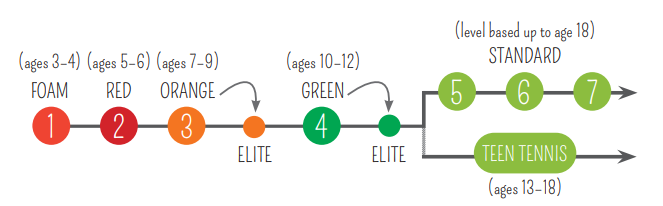
FLAC utilizes a USTA recommended pathway for youth and junior tennis, including low-compression tennis balls (Foam, Red, Orange, Green) for different age levels.
Rather than putting a young player on a full-size court with a standard yellow tennis ball right away, the pathway gradually increases the challenge. USTA guidance uses Red, Orange and Green balls as development stages, with lower-compression Foam balls helping younger players learn to control rallies and develop sound technique.
Why Does the Tennis Ball Color Matter?
Those different colored balls aren't just a fun way to organize youth tennis classes. The ball is designed to match the player's stage of development.
A standard yellow tennis ball travels faster, bounces higher and covers more space. For a young or inexperienced player, that can make it difficult to get into position, make consistent contact, and actually experience a rally.
Lower-compression balls slow the game down and make the court more manageable. This gives young players more opportunities to practice strokes, movement, rallying, serving and point play successfully. USTA describes this approach as a way to create age - and ability - appropriate tennis experiences that help players develop their skills.
Here's a look at the progression.
🟡 Foam Ball: Building the Foundation
For many of our youngest players, foam tennis balls are a great introduction to the game.
Foam balls are soft, slower-moving and easier for young children to track and control. They can help players become comfortable with:
Holding and swinging a racquet
Tracking a moving ball
Making contact
Developing hand-eye coordination
Moving toward the ball
Beginning to rally
Learning basic tennis terminology
Having fun on the court
This stage is about creating positive early experiences. A child doesn't need to hit a perfect forehand to be making progress.
Confidence comes first.
🔴 Red Ball: Learning to Rally
The Red Ball stage is the next step in the youth tennis pathway. USTA recommends red-ball tennis for younger players, generally around ages 5–7, although age should be viewed as a guideline rather than an absolute rule.
Red balls are slower and lower-bouncing than standard yellow tennis balls. This allows young players to spend more time developing fundamental skills and learning how to play the game.
At this stage, players can begin working on:
Forehands and backhands
Rallying with a partner
Serving fundamentals
Movement and positioning
Basic scoring
Cooperative and competitive games
Learning how to start and continue a point
The goal isn't simply to hit the ball. It's to learn how to play tennis.
🟠 Orange Ball: Developing the Player
As players become more comfortable with the Red Ball stage, they can progress to Orange Ball tennis.
Orange balls move faster and travel farther than red balls while remaining slower and lower-bouncing than a standard yellow ball. This is where players can really begin expanding their game.
Orange Ball development can include:
More consistent groundstrokes
Directional control
Serving
Spin
Rallying with greater depth
Movement and recovery
Net play
Point construction
Beginning tactical decision-making
The USTA notes that progression should be based on skill development and readiness - not simply age. Players can benefit from staying at a stage long enough to develop the skills needed for the next one.
🟢 Green Ball: Preparing for Full-Court Tennis
The Green Ball is the final transition toward traditional yellow-ball tennis.
Green balls have slightly reduced compression compared with a standard yellow ball. This allows players to experience the movement and tactics of traditional tennis while still having a ball that is more manageable than a standard yellow ball.
At the Green Ball level, players continue developing:
Full-court movement
Rally consistency
Serve development
Shot selection
Depth and direction
Offensive and defensive skills
Match play
Strategy and tactics
Competitive confidence
It's an important bridge between youth development and standard tennis.
How Do You Know When Your Child Is Ready to Progress?
One of the biggest misconceptions in junior tennis is that moving to the next ball as quickly as possible means your child is progressing faster.
It doesn't.
USTA development guidance emphasizes that transitions should be based on a player's technique, tactical skills, athletic development and readiness rather than treating the pathway like a race to the yellow ball.
A player may be the right age for Orange Ball but still benefit from additional time developing Red Ball skills. Another player may progress more quickly because of previous experience, coordination, or athletic development.
The right level is the level where your child can be challenged while still experiencing success.
That means parents shouldn't worry if their child spends extra time on a particular ball color. Developing strong fundamentals at each stage creates a better foundation for the next.
Keep Your Child Progressing
The best way to help your young tennis player progress is to focus on development rather than rushing milestones.
1. Let the coach guide the progression
Your child's coach can evaluate their technique, movement, rallying ability and overall readiness for the next stage.
2. Encourage consistency
Regular tennis exposure is more valuable than occasionally jumping into a more advanced level. Even short practice sessions can reinforce skills learned during lessons.
3. Celebrate rallies - not just wins
A longer rally, a better serve, improved footwork or successfully playing a point can all be signs of progress.
4. Give them opportunities to play
Lessons are important, but so is actually playing. Games, match play, and low-pressure competition help children learn how to use their skills in real situations.
USTA programs such as Team Challenge and Junior Team Tennis are designed to introduce competition in a lower-pressure environment while continuing skill development.
5. Don't rush the yellow ball
Yellow-ball tennis will be there.
The objective is to develop a player who is ready for full-court tennis - not simply a player who has reached it early.
From First Swing to Confident Player
The youth tennis pathway gives children a progression they can grow into:
Foam → Red → Orange → Green → Standard Yellow
Each stage presents a new challenge while building on the skills learned before it.
At Four Lakes Athletic Club, our goal is to help young players move through that pathway with confidence, consistency, and a genuine enjoyment of the game. Whether your child is picking up a racquet for the first time or working toward competitive junior tennis, the right progression can make the journey more productive - and a lot more fun!
Ready to find the right tennis program for your child? Explore junior tennis at Four Lakes Athletic Club and talk with our tennis professionals about where your player fits in the pathway.